Thursday, February 19, 2009

Singer's Plan to End Global Poverty

Peter Singer's new book lays out his plan for ending global poverty, in which over 3 billion human beings live on less than $2 a day (and a shocking 1 billion live on less than about $1.25 a day for all their essential needs). As this profile in The Observer explains, here is a way for the most privileged human beings to discharge their duties to the most poor:

Every person in the developed world ought to give at least 5% of their annual income to poverty relief efforts (such as Oxfam or Unicef). The rich ought to give more.

And to address the ad hominem that always follows Singer's argument: He gives about 25% of his annual income to Oxfam.

Labels: , ,

Saturday, November 22, 2008

What Should Obama's Global Ethical Priorities Be?

Ethicist Peter Singer outlines some of the moral challenges on a global scale facing the new Obama administration:

1) Restoring the U.S.'s image internationally by following through on the promise to close Guantanamo prison and pulling troops out of Iraq.

2) Helping to usher in reform at the United Nations by making it more democratic--meaning that something needs to be done by reducing the power of the five permanent members of the Security Council: the U.S., the U.K., France, Russia, and China.

3) Increasing the amount of foreign aid the United States provides to the world (currently about $25 billion/year, but still far less, as a percentage of overall GDP, than most industrialized nations)

4) Reducing carbon emissions and finding a way to become part of the discussion on enforcing the Kyoto treaty for the reduction of greenhouse gases.

What other global issues need to be addressed?

I would add a couple of considerations:

a) joining the Rome Statute and becoming part of the International Criminal Court system. The U.S. has failed to join because of worry that the Court might be used by other nations to engage in politically motivated prosecutions of U.S. leader and military personnel. We should move fast to become part of this growing system of global law with a policy of "constructive engagement" so that the U.S. regains its footing as a prime mover of global law and ethical norms. As it is now, our legal ideas are becoming less and less relevant to the world.

b) examining our commitment to trade agreements, such as NAFTA, and other bilateral agreements that we have with numerous Latin American nations and ensure that we are engaging in fair trade. NAFTA has undoubtedly affected immigration to the U.S., and that has raised issues of human rights along the border and the treatment of immigrants within the country (now that we have a vastly expanded immigration enforcement bureau under Homeland Security)

Labels: , , ,

Friday, June 27, 2008

Top 10 Global Intellectuals

As per Dennis's request, here are the top 10 public intellectuals of the world, according to Foreign Policy magazine:

1). Fethullah Gulen (Turkey)

2) Muhammad Yunus (Bangladesh--winner of the 2006 Nobel Peace prize!)

3) Yusuf Al-Qaradawi (Egypt)

4) Orhan Pamuk (Turkey--winnter of the 2006 Nobel prize in Literature!)

5) Aitzaz Ahsan (Pakistan)

6) Amr Khaled (Egypt)

7) Abdolkarim Soursh (Iran--"widely considered one of the world's premier Islamic philosophers")

8) Tariq Ramadan (currently in Switzerland, but considered to be another top Islamic philosopher)

9) Mahmood Mamdani (Uganda)

10) Shirin Ebadi (Iran--winner of the 2003 Nobel Peace prize!)

The first American shows up at No. 11--Noam Chomsky.

And the top write in candidate: Philosophy major Stephen Colbert!


Time to brush up on my Soursh and Ramadan!

Labels: ,

Monday, April 28, 2008

Who are you to say that? Moral Relativism on the Run

One of my classes never ends without a student bringing up moral relativism. I've said before here that the conservatives are wrong about "tenured radicals". Students don't learn how to be relativistic liberals in the university because of liberals; they seem to come to the university already believing that there is no such thing as a universal morality. One student told me the other day he thinks morality is even "personal"--each person gets to decide what is right and wrong. ( I told him that he had just earned an F for the class. He asked why. I said just because. I asked him if he thought it was unfair of me to do that to him. He said yes. I asked him what fairness could possiblity mean in his world where every individual gets to make up what is right and wrong.)

Peter Singer offers evidence to suggest that not only is there something like a global human ethic, but that there is moral progress. Fewer and fewer people around the world today believe that inequality based on race or ethnicity is justified. Gender inequality is still more acceptable,but less so than it was a few decades ago.

It may be the case that people only say they believe in equality when they actually do not practice justice and fairness. Singer cautions us not to underestimate the power of shaming the hypocrite. Ideals matter and if we can work to make them part of our everyday language and expectations, then we are contributing to moral progress.

Labels: ,

Wednesday, April 23, 2008

Who Makes Us Think? The Top Intellectuals in the World Today

Foreign Policy and Prospect Magazines are conducting a poll to determine who the top public intellectuals are in the world today. You can vote here for the top 5 individuals who have made significant contributions to their fields and have increased awareness of their ideas to broader spheres.

The third largest group in the top 100 are philosophers. What's interesting about the select group is the number of North Americans and Europeans. Could this be ethnocentric bias or a reflection of the difficulty of doing intellectual work in the rest of the world? What publics do global public intellectuals reach?

Labels: ,

Wednesday, February 06, 2008

Europe Up in Smoke

Europe is often referenced in discussions about the sorry state of welfare services in the United States. Look at how the Europeans offer national health care, or free education through university, or generous paid vacations!

But as this article reveals, European nations are displaying very surprising amounts of poverty and infrastructure decay. Much of the poverty centers around immigrants. It turns out that the United States isn't the only place that relies on cheap, undocumented workers to maintain the lifestyles of most of the native born citizens. But for some Europeans, coming to grips with this reality is difficult since for so long Europe has prided itself on being a more tolerant and generous place, with governments that care to offer real social safety nets for their peoples. Social justice, and global justice, have seemed to be more valued there in the minds of many Europeans.

But global justice concerns seem to be sneaking up in many different ways.

Take the case of the Netherlands. For years, the Dutch have been proud of their decriminalization of "soft drugs". It has given rise to the coffeehouse culture, so infamous among visiting American college students, in which people are allowed to use small amounts of marijuana within the cafes.

The problems come from the issue of the "back door". Cafes can sell small amounts to patrons through the front door, but they have to have a supply come from the back door. However, the Netherlands doesn't allow pot plantations in the country. So there is a demand, but not a system for a big market suppliers. The result is that people are growing marijuana in neighboring countries, such as Germany, to sell in the Dutch market.

The concern here is not so much with illegal pot growing. Greater decriminalization throughout the EU could take care of that and there are signs that this might take place in the next few years.

The global justice concern is that the market for drugs in the Netherlands creates suppliers elsewhere and, in some cases, fuels criminal enterprises. The Dutch are very proud of showing how they have an extensive health service to deal with addicts, and they have very few drug related deaths, as well as lower drug use than most other EU countries. But the Netherlands is also a major transit point for drugs being grown by West African drug gangs. About 80% of the pot used in the Dutch coffeehouses is domestic, but at least 20% comes from other places, and increasingly, this means cartels who are using young men and women as drug mules and prostitutes.

This is not a worry unique to the Netherlands. After all, drug demand in the United States fuels the drug cartels from Mexico to Colombia and the bodies line up all over the streets of Juarez and Cali. But it does mean that under such conditions of global inequality, the individual freedom to toke up cannot be seperated from a concern with the enabling situations that bring the pot to the coffeehouse counter (or the college dorm room) in the first place.

Labels: ,

Tuesday, October 09, 2007

Onwards Forever, Commander! Che Guevara 40 years Later


Today marks the 40th anniversary of the execution of Ernesto "Che" Guevara in the jungles of Bolivia. In this interview, Greg Grandin explains why Che remains an important figure in Latin American protest movements, especially those against neoliberal globalization. This photo display provides a portrait of the figure and his legacy in Cuba (at least in terms of great monuments).

Finally, doctors in Venezuela should be celebrating today as well--a 60% raise in honor of Che, who was a trained physician.

Labels: ,

Tuesday, October 02, 2007

Are Slum Tours Ethical?


In the early 19th Century, a South African woman named Saarjite Baartman was paraded around Europe as part of popular and scientific exhibitions.She came to be called the Hottentot Venus, known mostly for her especially large hips and buttocks. At one point, she was displayed in the center of London, naked, in a cage, for passerbys to see. Upon her death, Baartman was dissected and her gentalia examined by researchers in order to understand the "primitive" sexuality of African females. Such theories were often used to justify the continued colonial rule over Africa by the Europeans.

I'm reminded of Baartman upon reading of the phenomenon of slum touring. As this article points out, for between $10-20, tourists can have a guide take them through some of the largest slums in India. These are places with devastating poverty and overcrowding. One of the groups that conducts these tours claims that the point is not to objectify the inhabitants of these slums, but to show the world that these places are sites of industry and production, not just poverty. Part of the proceeds of these tours go to nongovernmental organizations working in these slums.

I wonder if these tours are really designed to be consciousness raising experiences or whether they simply amount to a kind of voyeuristic escapade that is not unlike the crowds in Picadilly coming to stare at Saarjite Baartman. It certainly seems important to become aware of the enormous poverty that affects so many human beings--the 3 billion people that live on less than $2 a day. But can wealthy Americans and Europeans do this without turning "Third World" people into spectacles? In the past, such experiences usually didn't result in more understanding of, or sensitivity to, other cultures--they simply reinforced people's prejudices. Most of the people who went to see Baartman were not inspired to investigate her Khosian culture or ask questions about European colonialism--they went to see how "uncivilized Africans" are different, and probably inferior, than good Englishmen.

Can a slum tour be more than just amusement for the privileged?

Labels: , ,

Monday, August 20, 2007

"All the world needs is xenophilia, sweet xenophilia"

Many of us are aware that the United States is perhaps the stingiest of industrialized nations in terms of providing nonmilitary foreign aid. As Peter Singer aruges in his book, "One World", the fact that we spend several billion dollars on soda pop and movie tickets each year, and less than $20 billion dollars on helping to provide drinking water and medicine to the world, is a moral failing of our society.

But what about the Danish? They are among the most generous of the industrialized nations. And yet, they have the most restrictive immigration policies in Europe. This has lead to a phenomenon that some are calling the "Copenhagen syndrome"--the Danish want to help the poor of the world, as long as they stay in their own neighborhoods and don't come to Denmark. Helping a neighbor is important, as long as they don't come over for dinner.

The Copenhagen syndrome raises an interesting question about our global village: is it moral to help developing nations in a globalized world but, at the same time, prevent the free flow of immigrants into our society? The United States, of course, is not committed to either the aid or the free flow. Should it be?

Christopher Phillips, in this interview from Philosophy Now, talks about his new book, "Socrates in Love". Phillips says that the most important variety of love he studied in preparing the book is xenia, the love for strangers. He describes how this does not mean that we must actually care for each single person we encounter, but that having xenia means being open to the new experience that the stranger offers, including the possibility of wisdom.

We might say that the Danish fail by this standard. They are generous, but they are not virtuous, in terms of xenia, if they are not open to having strangers come to live in their midst.

How important, then, is the stranger to our moral development in a global village?

Labels: , ,

Wednesday, July 11, 2007

Is your carbon footprint stepping on the global poor?

A couple of the reasons given by the U.S. for not ratifying the Kyoto treaty to reduce green house emissions is that it would do very little to stop big global polluters, such as China, and would have a big negative impact on the American economy. This interesting graphic represents the carbon footprint of each state as equivalent to some nation in the world. Seems clear that the U.S. has a significant ability to affect the global environment.


This map also suggests that state regulation on environmental issues can possibly be quite effective. The battleground is never too small to make a difference. You can check out the figures used for calculating the map here.

As to the negative impact on the economy: here's a graphic that represents each state as comparable to the GDP of some nation in the world. Figures are explained here. Given the low levels of foreign aid that the U.S. gives to the world, then, perhaps, a little give is called for in the name of global justice?


Labels: ,

Tuesday, June 26, 2007

Did your Dasani kill a baby?


Two weeks ago, I participated in OSU's commencement ceremony in which several thousand students graduated. We sat under the hot sun for a few hours with great anticipation. But to soothe us in our wait, the OSU Alumni Association had provided large bottles of water under each seat. At the end of the ceremony, there were dozens of unopened bottles, and half drunk ones, all around Reser Field.

At the same time, research at OSU is pointing out how environmentally unsound bottled water is. Professor Todd Jarvis indicates that we spend about $20,000 a minute in the U.S. on bottled water. However, it is not better for us than normal tap water and there are serious environmental impacts as a result of having to produce the plastic bottles and ship them everywhere. About 1.5 million barrels of oil are used to produce the plastic for the bottles each year. and some 90% of them are not recycled, according to the Earth Policy Institute.

There may also be some important global justice implications involved in drinking bottled water. Peter Singer argues that in a world with so much wealth and income inequality (in which almost half the population must make do on less than $2 of purchasing power for all their housing, food, and health needs), drinking bottled water might be a luxury that we really should do without. Especially when we consider how the United Nations estimates that several million people die each year as a result of exposure to dirty water, then we might want to think about pouring billions of dollars into an industry that is essentially providing most of us with fur coats in summer.

Much of that money goes to soda corporations and almost none of it is reinvested into improving water systems. As the BBC reports, the world is facing a crisis in terms of access to potable water and future international relations (and wars) could be at risk. For the sake of a peaceful and just world, it seems we need to think about whether we can reduce our personal and institutional use of such products.

Labels: , ,

Monday, April 02, 2007

Sacred Knowledge: The Zuni and Globalization

An interesting piece from the Smithsonian Magazine on the Zuni people of Western New Mexico ties into our interview with Allison Davis-White Eyes on Native Americans and the National Geographic Society's DNA project. The Zuni are a small, but cohesive society that can boast of having many of their tribal members choose to stay or return to the pueblo.

What I found most interesting in the article is the view by one Zuni that their sacred wisdom is not something they think is important to share with people. Instead, it is the responsibility of elders to protect the sacred knowledge and guard it against being shared widely with people who might exploit it or misunderstand it.

This kind of attitude, if held by different Native American peoples, would explain the hesitancy to participate in the DNA mapping project. Yet, it also seems to point to a deep difference between Native and Western European ideas of knowledge.

At least since the Enlightenment, Western societies have held onto the idea of knowledge as a kind of power that sweeps away myth, religious dogmatism, and other forms of superstition, literally "illuminating" the world and dispelling darkness. Knowledge is something to be shared as part of humanity's journey toward progress and ever increasing amounts of social freedom (or so says Hegel) Under this kind of interpretive lens, it is easy to see why some people would categorize Native American sacred knowledge as folklore, myth, and superstition.

So is knowledge of the world something that ought to be shared with all of humanity? Is there something wrong with the Zuni way? For instance, what if Zuni sacred knowledge included knowledge of medicinal plants that could be used for treatment or cure of serious diseases? Would they have an obligation, in a globalized world, to share that?

Labels: ,

Sunday, March 25, 2007

Chiquita, Coke, Nestle: The Moral Cost of Clean Hands


It was reported this past week that the Chiquita banana corporation had paid almost 2 million dollars to the United Self Defense Forces of Colombia (AUC) for "protection money" between 1997-2003. The AUC are right wing paramilitary squads involved in the 40+year civil war in Colombia against the left wing guerilla movement, FARC. The AUC and the FARC are officially listed by the U.S. Government as terrorist organizations. Chiquita has agreed to pay $25 million in fines to the U.S. Justice Department. There is also discussion now that top Chiquita executives be extradited to Colombia for doing business with the AUC.

Chiquita does not seem to be alone in its dirty business in Colombia. Human rights NGOs have been accusing Chiquita, along with Coca Cola and Nestle, of collaborating with right wing paramilitaries, for many years now. As in most human rights abuses in Latin America, it is poor and indigenous people who are the ones swept up in the violence by such armed forces. The Coca Cola corporation, of course, denies invovlement, but the Chiquita case raises the question about whether or not doing business in Colombia can really be done with clean hands.

A few posts ago, I asked whether or not ordinary citizens can be held accountable for the crimes committed by their goverments. The Chiquita case raises another dimension: In this globalized world, can we, as consumers of products such as Chiquita bananas (or Coke or Nestle products) be held morally responsible for the kinds of violent crimes unleashed by multi national corporations?

A colleague of mine suggests that we might not be responsible, or at least as responsible, because consumers have a different relationship to corporations than citizens do to their governments. In a democracy, we can directly elect our leaders and hold them accountable; not so with a multinational corporation.

How responsible are people, qua consumers, for the crimes committed by corporations operating in a globalized world?

Labels: , ,

Tuesday, March 13, 2007

Native Americans, Modern Science, and Globalization


A new Engage podcast is now available. It contains my interview with Allison Davis-White Eyes, Director of the Oregon State University Indian Education Office.

In our discussion, we talked about the National Geographic Society's Genographic Project and that fact that many native groups have refused to participate in the DNA sampling. The goal of the project is to provide detailed genetic maps of human migration over the entire globe. Davis White-Eyes tries to give us reasons for why Native Americans might be hesitant to go along with this collection process.

The most interesting part of this podcast for me was when we started to discuss the meaning of being a "globalized Indian". Davis-White Eyes claims that because of the interconnectivity of the planet, now in the era of globalization, native peoples might have a special responsibility to "indigenize" the world. This means more than simply promoting an end to discrimination and inequality for native peoples, but pushing for some kind of dynamic transformation of philosophical/scientific/political world views to reflect indigenous values.

There is definitely a movement underlying some her comments. In Latin America, there is now discussion of "interculturality". Indigenous leaders in Peru, Ecuador, and Bolivia are urging the rejection of "multiculturalism" (which means finding a way for different communities to live side by side) and the adoption of "Interculturality" (which means finding a way for different communities to inform and interact with one another and develop new principles of cooperation that reflect creative sythesis). Indeed, this principle is quickly becoming a model for building schools and designing curricula in Latin America.

A good book that examines the effect that interculturality will have in our understanding of what it means to be indigenous and the future of the Americas is Walter Mignolo's "The Idea of Latin America".

Labels: , ,

Wednesday, January 10, 2007

Immigration and the Globalization of Food

The New York Times reports today that the new Democratic leadership is considering reviving immigration legislation that floundered because of Republican opposition right before the November elections. The new legistlation would create paths to citizenship for immigrants and their families who can show that they have been working and not breaking criminal law that poses physcial threats.

The article reports that the immigration reform movement is getting support from American farmers who last year had to watch thousands of acres of crops go to waste because there were not enough workers during harvest time. One farmer claims that if some reform doesn't occur, allowing Mexican labor to work the fields, then key agricultural industries will be "outsourced" to foreign countries.

This globalization of the food chain is worrisome not only because of the loss of American agricultural jobs and the erosion of American farmers. It also raises questions about the health and quality of the produce in the chain.

A couple of years ago, The Orange County Registar did an investigation which found high levels of lead in candy imported from Mexico. Much of the contamination came from the packaging of the candy and there were also indications of lead contamination in the soil where the chile was grown that was put on the candy.

This reminded me of accounts by a friend who studied farmworker conditions in Chile and told me that pesticides are continually used on grapes grown there. It turns out that in some seasons almost 90% of the grapes available in the United States are grown in Chile. In fact, some groups argue that significant portions of the fruits and vegetables imported to the United States test positive for high levels of pesiticides, some which are banned in the U.S. Recent studies show that children are much more sensitive to these chemicals and their effects.

In a globalizing world, concerns of immigration reform matter for the health and safety of all.

Labels: , ,

Sunday, December 17, 2006

Immigration and Family Values: "All They Will Call You Will Be 'Deportee""


Our friend Dennis alerts us to the week's news about the large immigration raids that netted about 1300 undocumented workers. The raids, part of Operation Wagon Train, raised another fear around immigration: identity theft. Many workers use fake IDs with old Social Security numbers. There is a booming underground business in these IDs (called mica chuecas). What was left out of the reports by Homeland Security this week is that these fake IDs held by undocumented workers are generating billions of dollars in Social Secuity taxes. Most of this money, taken out by employers in the form of payroll taxes, will never been seen by the workers themselves, but goes into the general SSA fund.

What many people found hard to deal with in these raids was how they separated families. Hundreds of children around the country had their parents arrested and husbands and wives were separated from their spouses.

This separation of families is not something new to Mexicans in the United States or to immigrant families now. In 1931, the United States mounted a massive repatriation program that sent almost half a million Mexicans and Mexican Americans back to Mexico. Many people were arrested and not allowed to contact their families. Many were actually American citizens, and not undocumented aliens. The plight of this group was captured in song by Woody Guthrie's song "Plane Wreck at Los Gatos".


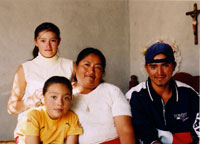
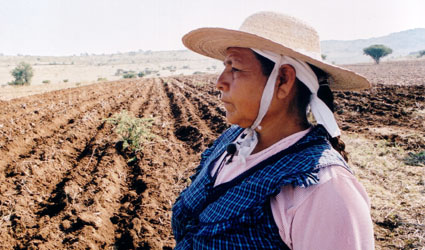
A wonderful documentary that captures the displacement and loss of family unity because of immigration is "Letters from the Other Side". I really recommend it for anyone who wants to see how trade policies such as NAFTA have affected rural Mexican families and put pressure on so many young men to cross the border looking for work. The result over the last 12 years is many communities in Mexico in which there is nothing but women and children trying to scrape by economically, dealing with the emotional loss and an indifferent Mexican government.

Labels: , ,

Saturday, September 16, 2006

Global Citizenship on the Horizon?


An article this week from the Economist confirms a point that came up in our podcast on immigration--immigration is increasingly a worldwide phenomena and people from developing nations are on the move in the hundreds and thousands. The European Union is going to meet to discuss immigration policy so that member nations are not undercutting one another's immigration policies. Hearings in Congress this summer have stifled the issue here in the U.S., even though Congress reports that the number of people dying along the border has almost doubled since the 1990s.

The Ecnonomist, however, recommends that the EU not take too much power away from its member states in setting immigration policy because citizenship is a concept that nation-states have a right to determine, not supra-national entities such as the European Union. This seems like a curious claim. In our podcast, Tony Vogt, Lisa Gonzales and I discussed how so much of the immigration we are witnessing today is a result of the pressure from economic globalization on developing countries. Victor Vargas echoed this point when discussing the politics of Mexico in July. It seems as if we are willing to talk about the free flow of goods and services across national boundaries in a globalized world, but we are still hesitant to talk about what it would mean to grant human beings those same political and civil rights to traverse territory. This brings up the issue of cosmopolitian citizenship. Should we be moving more and more toward the idea of guaranteeing human beings various kinds of rights that recognize we are not necessarily tied to one nation-state territory? This is the view maintained by David Held , who argues that we need to start recognizing the multi-layers of government that affect human beings today. Such a view does not mean that the nation state is now a "zombie" concept, but recognizes that nation-states, even very powerful ones like the United States, cannot control all policies that deeply impact the lives of people living within its territory. Is the idea of being a citizen of the world workable at last, or is this still too much of a utopian fantasy? What other ways are there to protect the well being of the thousands of people who are seeking to enter the U.S. and Europe and escape global poverty?

Labels: , ,

Monday, August 14, 2006

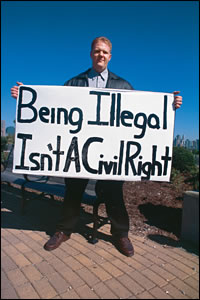
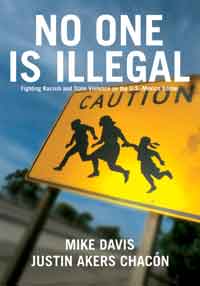
No Human Being is Illegal


Listeners who enjoyed the podcast on the ethics of immigration will enjoy Justin Akers Chacon and Mike Davis's new book, "No One is Illegal". Mike Davis provides a history of vigilante justice in California since the signing of the Treaty of Guadalupe Hidalgo in 1848. He shows how lower middle class communities formed associations to keep immigrants and labor organizers in check, usually through vicious attacks and coaltions with business leaders and farmers to rig political processes. Davis ends his short section by suggesting the the Minutemen are simply the most recent manifestations of this vigilante history. Chacon does a masterful job of giving social and economic context to the recent waves of Mexican immigration, trying to show why it is largely a result of changes in Mexican fiscal policy over the last thirty years, as well as neoliberal corporate globalization that is changing how Mexico and the United States rely on one another. His analysis clearly supports the contention made by Lisa Gonzales in our podcast that middle class life in the United States is largely propped up by the presence of these low wage workers.

The most recent issue of The Nation magazine focuses attention on the New Nativism that has arisen in the United States. The Nation series contains an insightful article by Bob Moser that talks about the wave of Latino immigration in the South. Another piece dissects the political messages of CNN's commentator Lou Dobbs who seems to be engaging in a one person crusade against Mexican immigration and spreading coded white supremacist ideas over cable news.

The immigration proposals that came out of the Senate have stalled this summer as the House has called for hearings all around the country to study the issue more. This seems like it might be a stalling technique so the issue will die out before the November Congressional elections. There is also word on the street that immigration advocates are hoping for the same thing because they disapprove of the proposals as they have been watered down by the Senate. The farm workers union here in Oregon, PCUN, has issued a statement that suggests this idea.

Labels: ,

Wednesday, August 09, 2006

Future of Democracy in the Americas


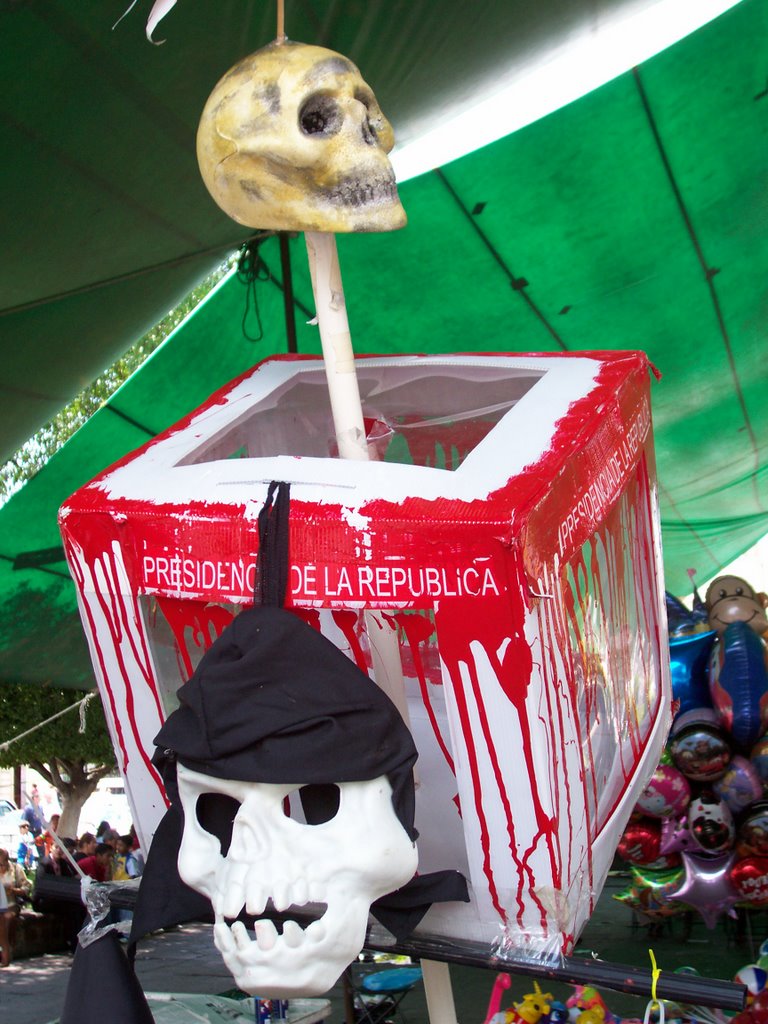
We recorded the interview with Victor Vargas in the middle of July 2006, just a couple of weeks after the July 2 presidential elections in Mexico. The emotions among the Mexican voters were still raw, as evidenced by the public art displays I found in the public squares in downtown Morelia, Michoacan. The time was perfect to talk about the past and future of Latin American democracy. The Letter to Jamaica by Simon Bolivar that I mention in the podcast is an important document in the history of Latin American independence and Victor did well to put it in context. In the Letter, Bolivar calls for Latin America to choose an independent course and develop political institutions that fit the culture and history of Latin America.

The election crisis in Mexico is reminescent of the 2000 election here in the United States. In fact, there have been extremely close elections in several countries in the past few years. I asked Victor about this in private conversation and he told me he thought there is a global political polarization going, fueled by neoliberal globalization policies and the War in Iraq. In Latin America, this polarization, according to Victor, is promoting the rise of leftist politicians such as Hugo Chavez in Venezuela, Evo Morales in Bolivia, and Michelle Bachelet in Chile, and Andres Manuel Lopez Obrador in Mexico. So its not clear whether its possible for Latin America, given the fact of globalization, to fufill the mandate of Bolivar's Letter any longer or whether these figures are, in fact, trying to do just that.

The other aspect that I found quite interesting in Victor's analysis is his point that democracy is more than just political--its a way of life. This means that it takes more than just frequent elections to count a society as democratic. Such an idea echoes the thoughts of American philosophy John Dewey, in his essay Creative Democracy: The Task Before Us, and more recently, Cornel West's Democracy Matters, an except which is here. It raises some deep questions about the success of military interventions in Afghanistan and Iraq. Can democracy take root this way?

The situation in Mexico is unclear at this time. The federal elections tribunal voted in the last week not to do a complete recount of all the votes, as was the preference of Andres Manuel Lopez Obrador. Instead, there is now a recount of approximately 9% of the votes. Lopez Obrador's supporters have staged major protests in the last few weeks, shutting down access to the center of Mexico City and threatening to shut down the international airport and key ministries. A president must be certified by the beginning of September 2006 to take office in December.

Labels: ,